The textbook case
Growth weakens
Equities fall
→
Rates fall
→
Bonds cushion the loss
This is the environment in which 60/40 behaves as expected.

White PapersAll Regime
Building portfolios for an uncertain world.
A portfolio should not depend on one macroeconomic forecast being right. It should own several independent return drivers, adapt when regimes change and retain access to explicit protection when ordinary diversification fails.
The problem
Traditional diversification
A 60/40 portfolio is diversified by asset-class label. It is not necessarily diversified by economic risk. Its defensive promise rests heavily on one relationship: when equities fall, bonds should rise.
The textbook case
This is the environment in which 60/40 behaves as expected.
The inflation case
The intended diversifier is exposed to the same shock as the growth engine.
The consequence
The portfolio discovers that it was less diversified than it looked.
When inflation was the shock
These periods do not make 60/40 “wrong”. They show why it should not be treated as a complete answer to every regime.
Global 60/40 real return per annum after inflation
Global 60/40 return as equities and bonds declined together
Source: Capicraft calculations. The 1972–1979 figure is a historical inflation-regime analogue; the 2022 figure forms part of the hypothetical systematic comparison. Returns are in USD.
“The problem is not that 60/40 never works. It is that one economic relationship is asked to do too much of the portfolio’s defensive work.”
Start with economic regimes
The All Regime approach begins with the direction of economic growth and inflation. The map is a portfolio-design tool, not a forecasting model. The question is whether the portfolio has credible sources of return if the future differs materially from the recent past.
Productive assets remain core long-term return generators, but they should not be responsible for virtually all portfolio return.
Equities · selected property · enterprise valueHigh-quality fixed income can provide liquidity and recession protection, but remains sensitive to inflation and starting yields.
High-quality bonds · cash · contractual incomeScarcity, replacement cost and monetary conditions introduce economic drivers that differ from conventional financial assets.
Precious metals · energy · infrastructure · commoditiesTrend, relative value and selected alternatives can contribute returns less dependent on growth and discount-rate outcomes.
Trend · relative value · selected alternativesA three-layer architecture
Even a well-diversified starting portfolio can be wrong. Trend and convexity add two different forms of adaptation.
What if our macro forecast is wrong?
What if the starting portfolio is wrong?
What if markets move too quickly or violently?
The five-year record
All Regime is the investable systematic anchor; Global Creator is the active expression. Creator can depart from the anchor through valuation, positioning, security selection and the cost of protection.
Flexibility without an anchor becomes drift. An anchor without flexibility becomes dogma.
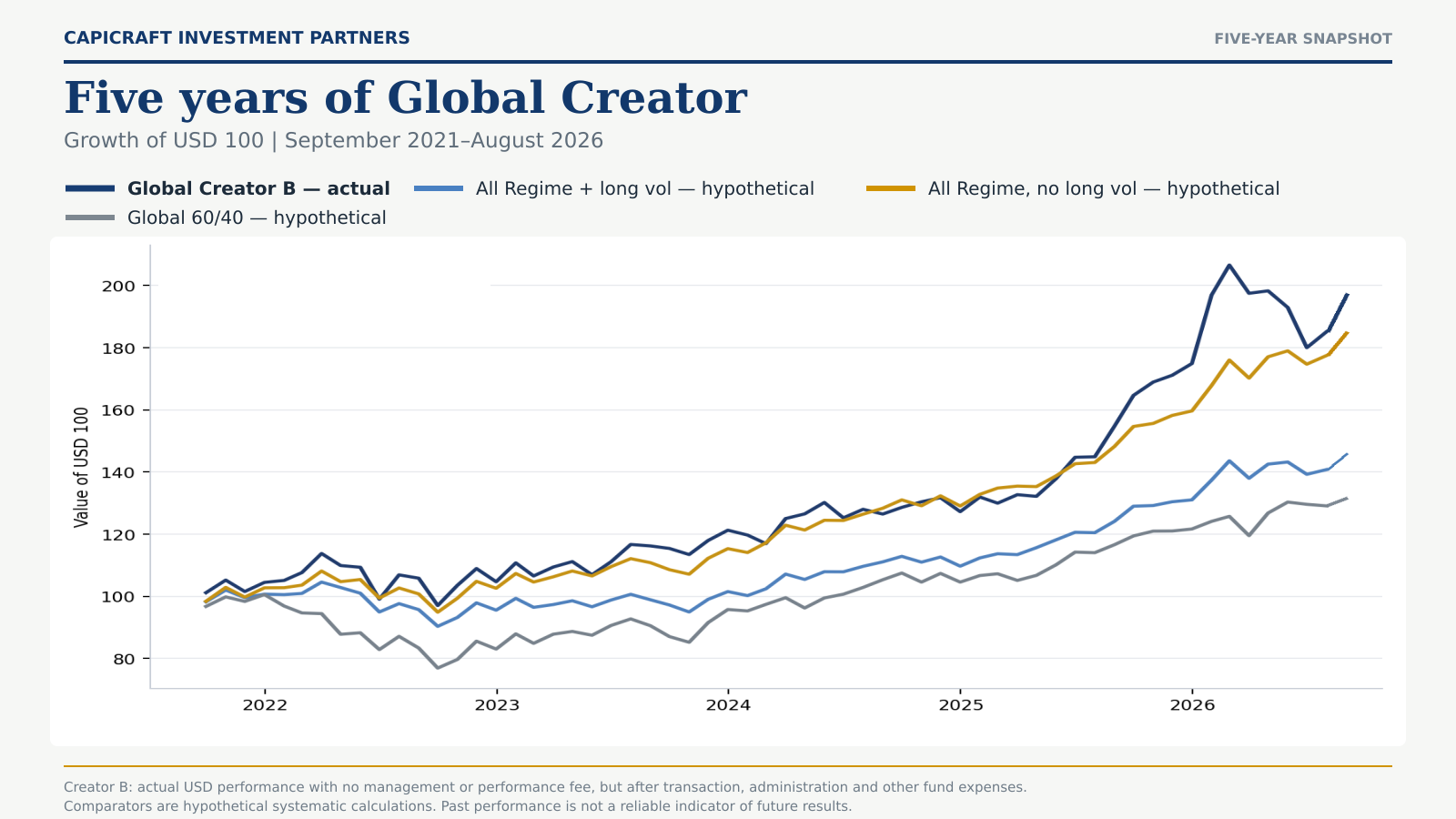
USD 100 grew to USD 197.4 in Creator B versus USD 131.5 in global 60/40. The realised record is economically meaningful, but it does not suggest that discretion removes risk.
Creator realised more volatility than the systematic models. Protection has a cost, trend can struggle in reversals and broad diversification can lag a concentrated growth portfolio in benign regimes.
From model to portfolio
The systematic framework makes the economic risks explicit and repeatable. Creator adds active judgement around that anchor.
These are potential sources of value, not guaranteed alpha. Discretion can also detract when judgements are wrong.
Liquid building blocks
Rules-based construction
Explicit portfolio roles
Position sizing
Security selection
Dynamic risk management
The objective
We cannot know with confidence whether the coming decade will resemble the 2010s, the 1970s, a post-war financial-repression environment or something investors have not yet experienced. A successful portfolio should not require us to know.
Read the research
The complete 19-page paper sets out the historical context, portfolio architecture, systematic evidence, stress periods, inflation analogue and the relationship between All Regime and Global Creator.
This material is issued by Capicraft Investment Partners, an authorised financial services provider (FSP 46098), for general information and research discussion. It is not personal financial advice, a recommendation, an offer or a solicitation. Historical modelled or backtested results are hypothetical unless explicitly identified otherwise. Global Creator B figures are actual returns over the stated period with no management or performance fee, but after transaction, administration and other fund expenses. Past performance, whether actual or hypothetical, is not a reliable indicator of future results. Investment values can rise or fall and investors may receive less than the amount originally invested.